Seattle receives an average of 38 inches of rain annually. We experience 152 days of measurable precipitation per year. Our humidity levels hover between 70-80% most months. We're famous for gray skies, persistent drizzle, and damp conditions that permeate everything.
Yet most garage floor coating companies throughout the Puget Sound never test concrete moisture before installation.
That single omission explains why garage floor coatings fail at such alarming rates in the Pacific Northwest—and why moisture testing is the difference between a coating that lasts 40 years and one that fails within 18 months.
Concrete is porous. It contains countless microscopic capillaries that transport moisture through the slab. In drier climates, this moisture management might be a minor concern. In Seattle? It's the dominant factor determining coating success or failure.
Consider what's happening beneath your garage floor right now:
The soil under your foundation contains moisture—sometimes significant amounts following our wet winters. That moisture moves upward through the concrete via capillary action. During dry summer months, moisture evaporation from the concrete surface creates a pressure gradient that pulls more moisture upward. During wet months, water can also penetrate from the sides of the slab.
Your concrete slab is essentially a moisture highway, with water vapor constantly trying to move from the wet soil below to the drier air above.
Now imagine sealing that concrete with an impermeable coating.
When you apply garage floor coating without understanding your concrete's moisture dynamics, you're essentially capping a moisture system that needs to breathe. The results are predictable and disastrous.
Stage 1: The Hidden Problem (Months 1-6)
Initially, everything looks perfect. The coating adheres to the concrete. The floor looks beautiful. Homeowners throughout Bellevue and Redmond feel satisfied with their investment.
But beneath the coating, moisture continues moving upward through the concrete. With nowhere to evaporate, it accumulates at the concrete-coating interface. Pressure builds.
Stage 2: Visible Warning Signs (Months 6-18)
Careful observers notice something strange: small bubbles appearing in the coating. These might be dismissed as application imperfections, but they're actually the first visible sign of moisture pressure overcoming coating adhesion.
In corners and along edges—areas where moisture tends to concentrate—the coating may appear slightly lifted or showing a subtle white haze (salt deposits from moisture bringing minerals to the surface).
Stage 3: Catastrophic Failure (Months 18-36)
The coating delaminates. Large sections peel up like old wallpaper. What was once a beautiful floor becomes an eyesore worse than the original bare concrete.
Homeowners are baffled. "The installer said this coating was guaranteed for 10 years! What happened?"
What happened was moisture. The one variable that was never tested or addressed.
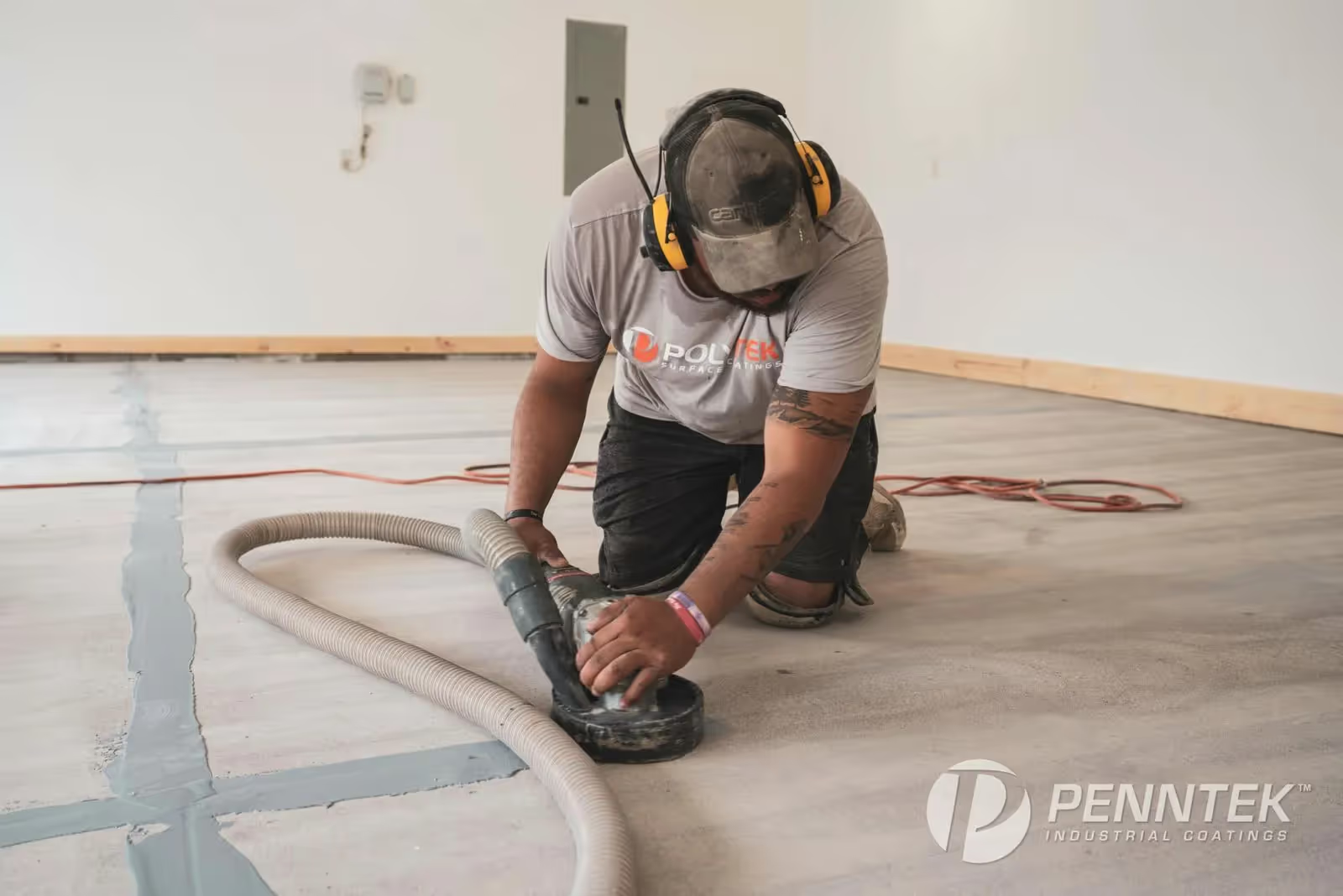
Certified Penntek dealers don't guess about moisture. We test using calibrated equipment that provides objective data about your specific slab's moisture emission rate.
Calcium Chloride Testing (ASTM F1869)
This method measures the moisture vapor emission rate (MVER) from your concrete surface. We place calcium chloride crystals in a sealed container on the concrete, leave them for 60-72 hours, then weigh the crystals to determine how much moisture they absorbed.
The result is expressed in pounds per 1,000 square feet per 24 hours. Most coating systems can tolerate MVER up to 3-5 pounds. Above that threshold, moisture mitigation is required.
Relative Humidity Testing (ASTM F2170)
This method involves drilling small holes into the concrete at 40% of the slab depth (the point where moisture content is most representative of overall slab conditions), inserting specialized probes, and measuring relative humidity.
Results above 75% RH typically require moisture mitigation. Results above 85% RH make coating installation inadvisable without extensive moisture control measures.
Why Both Tests Matter
Calcium chloride testing measures surface moisture—what's trying to escape right now. RH testing measures internal moisture—what's coming in the future. Both metrics inform system selection.
A slab might show acceptable surface moisture but high internal RH, suggesting moisture problems will emerge later. Or a slab might show high surface moisture but acceptable RH, suggesting a temporary condition that will resolve.
Professional analysis of both metrics guides proper system selection.
Pacific Northwest concrete presents unique characteristics that affect moisture management:
Seasonal Variability
Seattle moisture levels fluctuate dramatically with seasons. A concrete slab tested in August (following our dry summer) may show acceptable moisture levels. That same slab tested in February (after months of rain) might fail moisture tests dramatically.
Smart installers know to test during or shortly after wet seasons to understand worst-case moisture conditions. Testing during summer dry periods provides unrealistically optimistic data.
Older Construction Methods
Homes built before 1990 often lack vapor barriers beneath concrete slabs. This was standard construction practice—nobody understood that moisture migration through concrete would become a coating industry concern decades later.
Sammamish and Bothell homes from the 1970s-80s almost always lack adequate vapor barriers, meaning they have direct moisture pathways from soil to concrete surface.
Grade and Drainage Issues
Seattle's hilly terrain means many homes have grading that directs water toward foundations rather than away. Poor drainage around garage perimeters creates moisture problems that compound over time as water saturates the soil beneath slabs.
Concrete Age and Porosity
Concrete becomes more porous over time as freeze-thaw cycles create microcracking and chemical reactions degrade the slab's density. A 40-year-old Seattle garage floor is typically 30-40% more porous than when originally poured.
This increased porosity allows more moisture to travel through the slab, making proper coating system selection even more critical.
Once we understand your concrete's moisture profile, we can select the appropriate coating system. This is where the Penntek advantage becomes clear.
Low Moisture Slabs (< 3 lbs MVER, < 75% RH)
These slabs can accept standard Penntek polyurea systems without additional moisture mitigation. The chemical bond created by silane adhesion promoter is sufficient to maintain adhesion despite minor moisture presence.
Even here, Penntek outperforms competitors. The chemical bond's resistance to moisture intrusion exceeds mechanical bonds by orders of magnitude. While cheap epoxy might begin delaminating at these "low" moisture levels, Penntek remains unaffected.
Moderate Moisture Slabs (3-5 lbs MVER, 75-85% RH)
These slabs require moisture mitigation primers before coating application. Penntek's primer systems create moisture-tolerant bonds that allow the coating to remain intact despite elevated moisture conditions.
This is where many coating companies simply refuse the job. They know their mechanical bond systems can't tolerate these conditions. Rather than invest in proper moisture mitigation, they walk away—or worse, they install anyway and hope the homeowner doesn't connect eventual failure to their poor system selection.
High Moisture Slabs (> 5 lbs MVER, > 85% RH)
These slabs require extensive moisture control—potentially including external drainage improvements, internal moisture barriers, or specialized high-moisture coating systems.
Honest installers discuss these requirements during the estimate phase. They explain that successful coating requires addressing the moisture source, not just applying stronger coatings.
Companies that don't test moisture never have these conversations. They install mechanical bond systems over high-moisture concrete and hope they've collected payment before failure becomes obvious.
Why can Penntek polyurea tolerate higher moisture conditions than competitors? The answer lies in adhesion chemistry.
Mechanical Bonds and Moisture
Standard epoxy creates mechanical bonds—physical interlocking between coating and concrete texture. Moisture interferes with this bond in two ways:
Think of trying to glue two pieces of wood together while one piece is wet. The moisture prevents adhesive contact and weakens the bond. That's mechanical bonding in moisture conditions.
Chemical Bonds and Moisture
Penntek's silane adhesion promoter creates chemical bonds at the molecular level. These bonds don't depend on surface texture—they're actual chemical reactions between coating molecules and concrete molecules.
Moisture doesn't prevent these chemical bonds from forming. The silane adhesion promoter is specifically designed to function in moisture-present conditions. In fact, some moisture actually facilitates the chemical bonding reaction.
Once formed, these chemical bonds are essentially permanent. The coating becomes part of the concrete structure. Moisture can't break these bonds because they're not mechanical connections—they're molecular level integrations.
The Kirkland Condo Complex (2018)
A 24-unit condo complex in Kirkland had all garage floors coated with budget epoxy. None of the slabs were moisture-tested. All installations occurred in August following a dry summer.
By March 2020 (following a typically wet Pacific Northwest winter), 18 of 24 floors showed extensive bubbling and delamination. Calcium chloride testing revealed MVER levels ranging from 6-11 lbs—well above acceptable thresholds for epoxy coating.
The coating company's response? "This must be a concrete problem. Our warranty doesn't cover substrate issues."
The actual problem? Installing moisture-intolerant coatings over concrete without ever testing moisture levels.
The Issaquah Home (2019)
A homeowner in Issaquah paid $2,400 for "one-day polyurea flooring." No moisture testing occurred. The installation looked beautiful.
Fourteen months later, the coating was peeling extensively along one wall. RH testing revealed 89% relative humidity—the concrete was essentially saturated with moisture from poor exterior drainage.
The installer's solution? "We can re-coat it, but you'll need to pay for another installation."
The proper solution? Fix the drainage issue, allow the concrete to dry (potentially months), apply moisture mitigation primer, then install moisture-tolerant coating.
The Redmond Success Story (2020)
A Redmond homeowner contacted us about coating his 35-year-old garage floor. Our moisture testing revealed concerning MVER of 4.8 lbs and RH of 82%.
We explained that successful coating required moisture mitigation. We recommended addressing exterior drainage, applying specialized moisture-tolerant primer, and using a Penntek system specifically formulated for moderate-moisture conditions.
Total investment: $3,900 (vs. $2,800 for standard installation)
Four years later, the floor remains perfect. No bubbling. No delamination. The chemical bond remains intact despite elevated moisture conditions.
The homeowner's comment: "You could have installed the cheap system and I wouldn't have known the difference for a year or two. Thank you for being honest and doing it right."
When interviewing coating companies for your Seattle-area garage, these questions will quickly reveal which ones understand moisture management:
1. "Will you test my concrete's moisture before providing a quote?"
Correct answer: Yes, using calibrated calcium chloride and/or RH testing equipment.
Red flag answer: "We don't need to test—we've been doing this for X years and can tell by looking."
2. "What moisture levels are acceptable for your coating system?"
Correct answer: Specific MVER and RH thresholds with explanation of moisture mitigation options if thresholds are exceeded.
Red flag answer: Vague assurances that their system works in "all conditions" or dismissiveness about moisture concerns.
3. "What happens if moisture testing reveals elevated levels?"
Correct answer: Discussion of moisture mitigation options, potential drainage improvements, or specialized high-moisture systems.
Red flag answer: Suggestion to proceed anyway or claims that their coating is "moisture-proof."
4. "Is your warranty valid if moisture problems emerge?"
Correct answer: Clear explanation of warranty coverage, including moisture-related failures.
Red flag answer: Disclaimer that warranty doesn't cover "concrete issues" or "moisture problems."
Certified Penntek dealers approach every installation with moisture awareness because the product formulation allows us to succeed where competitors fail.
The silane adhesion promoter technology in Penntek's basecoat creates moisture-tolerant chemical bonds. The 99% pure polyurea formulation resists moisture intrusion. The system's flexibility accommodates the slight concrete movement that moisture can cause.
This doesn't mean Penntek ignores moisture—it means we can successfully coat slabs that other systems simply can't handle.
Throughout Woodinville, Sammamish, and the greater Seattle area, we've successfully installed floors in conditions where epoxy and mid-grade polyurea would fail within months.
Seattle's climate doesn't make garage floor coating impossible—it makes expertise mandatory.
Homeowners who understand moisture dynamics choose installers who test, analyze, and select appropriate systems based on data rather than guesswork.
The difference between a coating that lasts 40 years and one that fails within 18 months often comes down to a single variable: moisture. The installers who test for it succeed. Those who ignore it fail.
When you're ready to coat your garage floor the right way—with proper moisture testing, honest system recommendations, and chemical bond technology that tolerates Pacific Northwest conditions—contact Cascade Concrete Coatings for a free consultation.
We'll test your concrete's moisture levels, explain what the data means, and recommend the system that will succeed in your specific conditions.
Because in Seattle's climate, hoping your coating will work isn't enough. You need chemistry that's proven to work.