The most common question we get after price is this one: how long is this actually going to last? It's the right question to ask before you spend money on anything that involves coating concrete and putting it through daily use. The honest answer is: it depends entirely on the system installed and the quality of the installation — not on the marketing language used to describe it.
Here's a straightforward breakdown of what the three main coating types deliver in terms of lifespan, what factors shorten that lifespan in the Pacific Northwest specifically, and what you need to see from an installer to have confidence the floor will last as long as they claim.
Basic epoxy floor coatings, including the roll-on water-based systems sold at hardware stores and installed by lower-cost contractors, typically last 3 to 7 years in normal residential use. Under Pacific Northwest conditions, that range skews toward the shorter end.
The reason is Washington's climate. Concrete slabs in Seattle, Woodinville, and the surrounding area experience significant moisture transmission year-round. Rain, groundwater, and seasonal humidity work their way up through the slab and create pressure beneath the coating. Epoxy's mechanical bond — which adheres to the surface of the concrete rather than fusing with it — is vulnerable to that pressure. Add Seattle's temperature swings, which cause concrete to expand and contract, and epoxy's brittleness becomes a liability. The coating cracks, bubbles, and lifts.
UV exposure makes it worse. Most epoxy formulations yellow and lose clarity within a few years of UV exposure — and garage doors let in more direct sunlight than most people account for when they're imagining the floor in finished form.
This doesn't mean epoxy is worthless. A professionally installed, two-part epoxy system on a properly prepared substrate can deliver 5 to 10 years of decent performance. It means that for a floor you intend to keep for 20 or 30 years, epoxy is a temporary solution that requires repeat investment. Learn more about the differences between coating types on our website.
The step up from standard epoxy is the category often marketed as "one-day floor coatings" or branded proprietary systems. These use a polyaspartic or polyurea topcoat over an epoxy or hybrid base — a meaningful improvement over pure epoxy in terms of UV stability and surface hardness.
Well-installed systems in this category typically last 10 to 15 years in residential use. The topcoat's UV resistance prevents the yellowing that kills basic epoxy. The harder surface handles vehicle traffic and dropped tools better. For homeowners who want a quality floor at a reasonable price and are comfortable with the idea of a mid-life redo, these systems represent legitimate value.
The limitation is the base coat. If the base coat is epoxy — even a high-quality one — the mechanical bond vulnerability is still present. And in the Pacific Northwest, where moisture and temperature cycling are persistent, that vulnerability matters over time. Our comparison of coating systems explains the base coat chemistry in plain language.
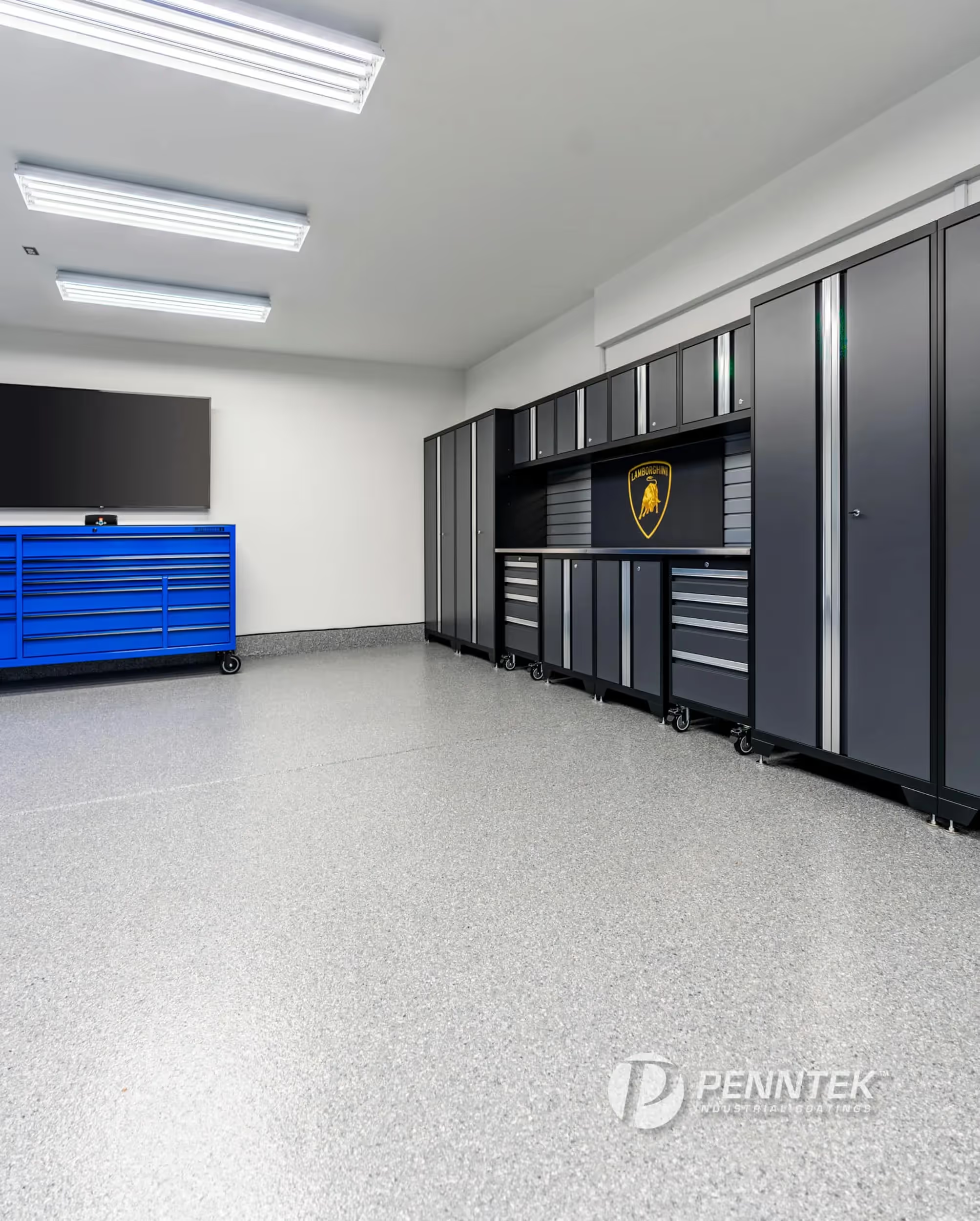
Certified Penntek polyurea systems are designed for 20 to 40-year lifespans in residential use. In moderate climates with proper installation, we regularly hear from homeowners 10 to 15 years out whose floors still look and perform like new.
The lifespan difference comes from two sources. First, the base coat chemistry. Penntek's pure polyurea forms a chemical bond with concrete at the molecular level — the coating fuses with the slab rather than adhering to it. This bond is so strong that the concrete would sooner crack than the coating separate. Moisture pressure, temperature cycling, and substrate movement don't overcome it the way they overcome mechanical adhesion. Second, FadeLock UV technology in Penntek's topcoat blocks UV penetration at the polymer level, preserving color integrity for decades rather than years.
The manufacturer-supported limited lifetime warranty that backs every Cascade installation isn't a sales tool — it's the manufacturer's confidence in their own chemistry. Penntek stands behind the product independently of the installer. For homeowners in Woodinville, Kirkland, Bellevue, and surrounding communities, that translates to a floor you genuinely won't need to replace. Read more about why Penntek certification matters.
Seattle-area homeowners face conditions that accelerate coating failure compared to drier climates. Understanding them helps you evaluate any installer's claims about lifespan.
Ground moisture. Western Washington has a high water table in many neighborhoods, and rain is consistent from October through June. Concrete slabs absorb and transmit that moisture upward. Any coating installed without proper moisture testing and moisture-appropriate system selection will face accelerated delamination pressure. Our blog post on moisture covers this in detail specific to the Seattle market.
Temperature cycling. While Seattle doesn't experience extreme cold like Minnesota winters, the cycle from cold, wet winters to warm, dry summers creates meaningful concrete expansion and contraction. Rigid coatings — especially basic epoxy — crack under this movement. Flexible coatings, like Penntek polyurea, move with the slab without compromising the bond or surface integrity.
Garage use patterns. Pacific Northwest homeowners tend to use their garages for more than just cars — workshops, recreational equipment storage, hobby spaces. Higher foot traffic and tool impact increase wear demands on the coating surface. This makes hardness and durability more important here than in climates where the garage is just a parking space.
When an installer quotes you a lifespan — 15 years, 20 years, lifetime — ask four follow-up questions.
First: Is that backed by the installer or the manufacturer? An installer lifetime warranty is only as good as the business that issued it. A manufacturer warranty survives ownership changes.
Second: What happens to the warranty if the coating peels due to moisture? Some warranties exclude moisture-related delamination unless a moisture barrier was installed. Know whether yours includes or excludes it.
Third: What testing did you do on my concrete before recommending this system? A lifespan estimate that doesn't account for your specific slab's moisture level, hardness, and crack history is a guess, not a projection.
Fourth: Can I see projects you've completed in this area that are 5 or more years old? Real-world performance in Pacific Northwest conditions is more meaningful than laboratory certifications.
If an installer can answer all four questions clearly and with specifics, you have a good foundation for trusting their lifespan claims.
If you're evaluating lifespan as a purchase criterion — and you should be — the numbers look like this: epoxy gives you 3 to 7 years under Pacific Northwest conditions, mid-grade poly gives you 10 to 15, and certified Penntek polyurea gives you 20 to 40 with proper installation. The cost difference between these systems is real but far smaller than the cost of redoing a failed floor — which includes emptying the garage, scheduling around the project, and paying for a second installation you shouldn't have needed.
We serve Woodinville, Redmond, Edmonds, Sammamish, and the broader Seattle area. A free in-home consultation includes moisture testing and a system recommendation specific to your slab — not a generic quote based on square footage. Contact us and we'll schedule it at your convenience.