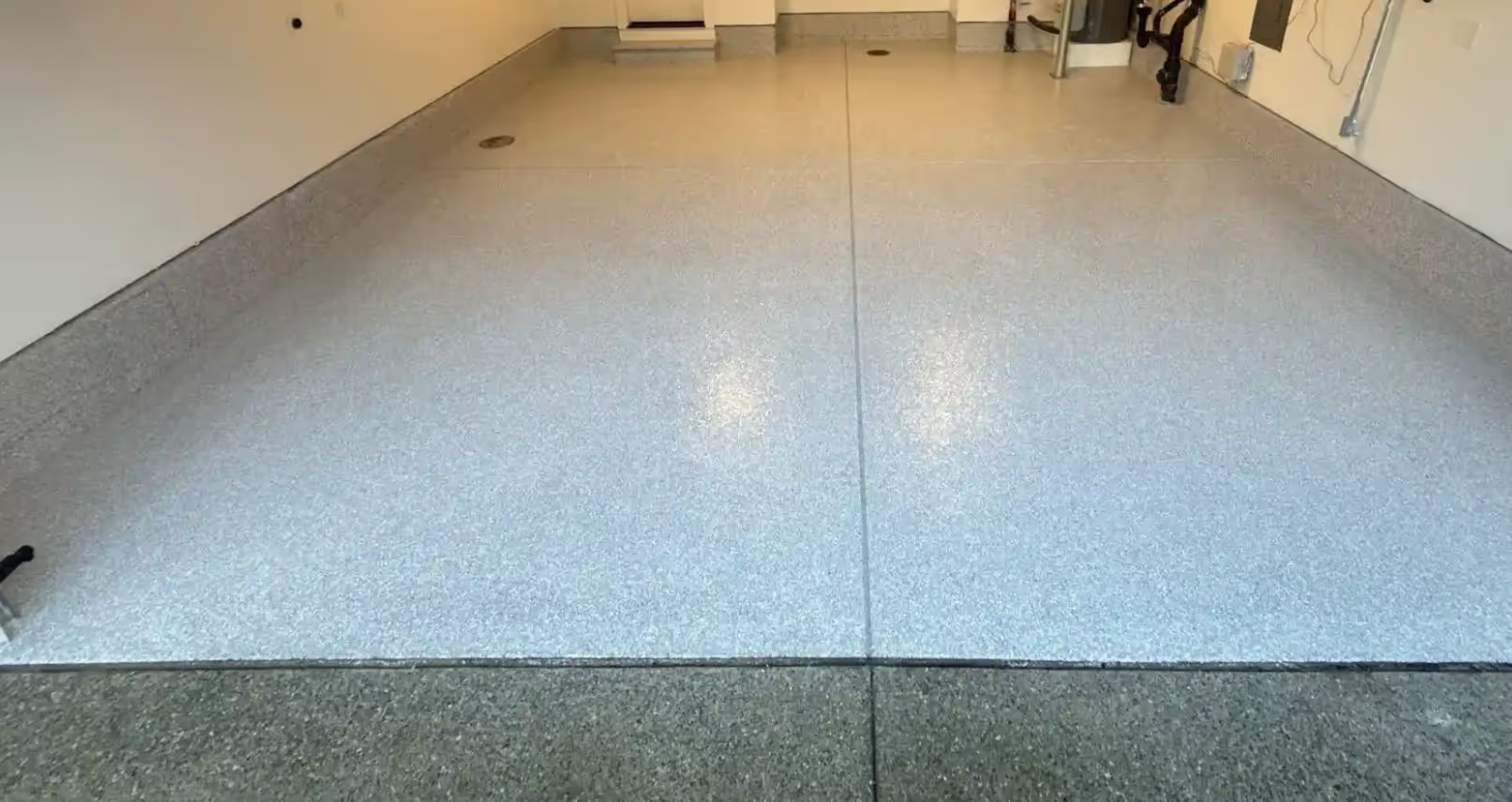
When Jennifer started researching garage floor coatings for her Kirkland home, she quickly became overwhelmed. Every company claimed to offer the "best" coating. Sales representatives used technical jargon she didn't understand. And the price quotes varied by 300%—from $1,200 to $3,600 for the same 450-square-foot garage.
"How can three different coatings all be 'the best'?" she wondered. "What am I actually paying for when I choose the expensive option?"
After her DIY epoxy experiment failed spectacularly in month 19, Jennifer became determined to understand the real differences between coating types. Her research led her to chemistry, industry standards, and the uncomfortable truth that most homeowners are sold inferior products because they don't understand what questions to ask.
This guide is what Jennifer wishes she'd read before making her first coating decision. It's the technical comparison that cuts through marketing claims to explain what actually differentiates epoxy, polyaspartic, and Penntek polyurea coatings—and why those differences determine whether your floor lasts 3 years or 40 years.
Before comparing specific products, you need to understand the three fundamental categories of garage floor coatings available in the Seattle market:
Epoxy has been the garage floor coating standard for decades. It's the coating most people think of when they imagine a "coated garage floor." Walk into any Home Depot or Lowe's and the DIY kits you'll find are epoxy-based.
Chemical Composition: Epoxy consists of resin and hardener components that chemically react when mixed. This reaction creates a hard, plastic-like surface that bonds to concrete.
The Mechanical Bond Problem: Epoxy creates what the coating industry calls a "mechanical bond." Instead of chemically bonding with concrete at the molecular level, epoxy physically grips the concrete's surface texture—like Velcro hooking onto fabric loops.
This mechanical bond is epoxy's fundamental weakness. It can be broken. Temperature changes cause concrete to expand and contract. Moisture creates hydraulic pressure from below. UV exposure degrades the epoxy's molecular structure. All of these forces work to separate the mechanical bond between epoxy and concrete.
Typical Lifespan in Seattle Climate: 3-7 years before significant yellowing, hot tire pickup, and delamination become problematic.
As epoxy's limitations became apparent, coating manufacturers developed polyaspartic and polyurea alternatives. These polymers cure faster, tolerate wider temperature ranges during application, and provide somewhat better UV resistance than traditional epoxy.
The Dilution Problem: Here's where the coating industry gets deceptive. "Polyurea coating" doesn't mean pure polyurea. Many mid-grade systems contain 40-60% polyurea with the remainder being filler compounds, cheaper polymers, or dilution agents.
These fillers serve the installer's interests (lower material costs, easier application, higher profit margins) but undermine performance. Lower solids content means:
The "Stretched" Product Issue: Throughout Bellevue and Redmond, fast-moving coating companies use bulk polyurea products that they "stretch" with additives to reduce per-job material costs. The resulting coating looks good initially but lacks the durability and longevity of pure polyurea formulations.
Typical Lifespan in Seattle Climate: 7-12 years before significant fading, reduced chemical resistance, and visible wear patterns emerge.
Penntek represents a fundamentally different approach to concrete coating. Rather than optimizing for easy installation or low material costs, Penntek's formulation prioritizes long-term performance and durability.
99%+ Pure Polyurea Solids: Penntek's basecoat contains over 99% pure polyurea—no fillers, no dilution compounds, no "stretching" additives. You're paying for actual protective coating material.
Silane Adhesion Promoter Technology: This is the critical differentiator. Penntek's basecoat contains enhanced silane adhesion promoters that create chemical bonds with concrete at the molecular level. This isn't a mechanical grip—it's an actual chemical reaction that integrates the coating with the concrete substrate.
FadeLock UV Protection: Penntek's proprietary topcoat contains UV-blocking additives that prevent color degradation. These compounds act like sunscreen for your floor, filtering out UV radiation before it reaches the color flake layer.
Advanced Flexibility Additives: Seattle's seasonal temperature swings cause concrete expansion and contraction. Penntek's flexibility additives allow the coating to move with the concrete without cracking, chipping, or delaminating.
Expected Lifespan in Seattle Climate: 30-40+ years with proper maintenance, maintaining showroom appearance throughout.
Understanding performance differences requires understanding chemistry. Let's examine the specific technical advantages that make Penntek superior to alternatives.
How Epoxy Bonds:
When epoxy is applied to concrete, it flows into surface pores and texture, then hardens. The bond strength depends entirely on how well the epoxy has penetrated surface irregularities and how much surface area is available for gripping.
Think of it like pressing two pieces of Velcro together. The bond is strong initially, but forces working perpendicular to the bond (moisture pressure from below, thermal expansion/contraction) can overcome the mechanical connection.
How Penntek Bonds:
Penntek's silane adhesion promoter operates at the molecular level. Silane compounds have a unique property—they can form covalent chemical bonds with both organic polymers (the polyurea) and inorganic substrates (the concrete).
When Penntek is applied to properly prepared concrete, the silane molecules create permanent chemical linkages between the coating and concrete. This isn't a mechanical grip that can be overcome—it's a chemical integration where the coating becomes part of the concrete structure.
Testing demonstrates this difference dramatically. When Penntek-coated concrete is subjected to pull-off adhesion testing using standardized ASTM methods, the concrete itself fractures before the coating separates. The bond is literally stronger than the concrete.
Why Coatings Yellow:
Ultraviolet radiation breaks down polymer chains through a process called photodegradation. When UV photons strike epoxy or lower-grade polyurea, they provide enough energy to break chemical bonds in the polymer backbone. This breaking and reformation of bonds changes the coating's molecular structure, resulting in discoloration (yellowing) and eventually structural degradation.
Seattle homeowners notice this most dramatically on garage floors with south-facing openings. Even our cloudy climate provides sufficient UV exposure to degrade unprotected coatings within 18-24 months.
How FadeLock Works:
Penntek's FadeLock technology incorporates UV-absorbing compounds into the topcoat formulation. These compounds absorb UV radiation before it can reach the basecoat and color flake layers.
Think of it as sacrificial protection—the UV-absorbing compounds take the damage instead of the coating's structural polymers. And because FadeLock compounds are distributed throughout the topcoat thickness, they continue providing protection as the surface experiences normal wear.
The result? Garage floors throughout Sammamish and Bothell that maintain their original color vibrancy for decades rather than yellowing within two years.
Penntek conducts a demonstration they call "the hammer test"—dropping a hammer from identical heights onto epoxy, mid-grade polyurea, and Penntek samples to compare impact resistance.
Results are dramatic:
This difference stems from Penntek's flexibility additives. When impact occurs, the coating can deform slightly (absorbing energy) then return to its original shape. Rigid coatings like epoxy can't deform, so all impact energy goes into breaking molecular bonds—resulting in cracks and chips.
For Seattle homeowners who use their garages as actual working spaces (dropping tools, moving heavy equipment, etc.), this impact resistance means the coating maintains its integrity under real-world use.
One of the most frustrating coating failures Seattle homeowners experience is "hot tire pickup"—dark marks left where vehicle tires sit after highway driving.
Why This Happens:
Tires reach 140-160°F during highway driving. When these hot tires sit on coating that lacks thermal resistance, the heat softens the coating surface. Tire plasticizers (chemicals that keep rubber flexible) then migrate into the softened coating, leaving permanent discoloration.
Cheap epoxy and mid-grade polyurea lack sufficient heat resistance. Within 12-18 months, most Seattle-area garages with these coatings show pronounced hot tire pickup patterns.
Penntek's Solution:
Pure polyurea has inherently superior heat resistance compared to epoxy. Penntek's 99%+ solids formulation means maximum heat resistance with minimal filler content that might soften under thermal stress.
Additionally, Penntek's topcoat creates an extremely hard, non-porous surface that resists plasticizer migration even under heat exposure.
Result: Garages throughout Kirkland and Issaquah where homeowners can park immediately after highway commutes without worrying about tire marks.
Product quality matters, but installation quality determines whether that product performs to its potential. Let's compare installation processes across coating types.
Surface Preparation: Acid etching or light grinding with consumer-grade equipment
Reality: Acid etching achieves ICRI CSP 1-2 profile—insufficient for durable coating adhesion. Consumer grinders lack the mass and diamond tooling necessary for proper surface preparation.
Application: Roll-on application with broadcast flakes
Reality: Achieving uniform thickness and proper flake distribution requires experience most DIYers lack. Uneven application creates weak points where failure initiates.
Cure Time: 24-72 hours before light traffic
Typical Outcome: Good appearance initially, failure within 18-36 months
Surface Preparation: Light to moderate grinding with entry-level professional equipment
Reality: Better than DIY but still typically falls short of ICRI CSP 3-4 standards. Many installers use surface scarifiers (cheaper equipment) rather than true diamond grinding systems.
Application: Spray or roll application with professional tools
Reality: Proper application, but if the product contains 40-60% filler content, even perfect installation can't overcome inferior chemistry.
Cure Time: 12-24 hours before light traffic
Typical Outcome: Acceptable performance for 5-10 years, then progressive degradation
Surface Preparation: Industrial diamond grinding to ICRI CSP 3-4 using 600+ pound equipment
Reality: This is the industry gold standard. Diamond grinding creates microscopic peaks and valleys that provide maximum surface area for chemical bonding. The resulting profile is visible under magnification—it looks like a mountain range at the microscopic level.
Moisture Testing: Calibrated equipment measures moisture vapor emission rate and relative humidity
Reality: This testing identifies potential moisture issues before coating application. Proper system selection depends on accurate moisture data.
Crack Repair: Meticulous identification and repair of all imperfections
Reality: Certified Penntek dealers are trained to identify even hairline cracks that might propagate. Proper repair materials are selected based on crack type (structural vs. surface).
Application: Professional spray application of pure polyurea basecoat, strategic flake broadcast, topcoat application
Reality: Penntek certification requires demonstrated competency in application techniques. Installers must maintain quality standards to retain certification.
Cure Time: 24 hours to full vehicle traffic
Typical Outcome: 30-40+ year lifespan with showroom appearance maintained throughout
Let's examine a typical 450-square-foot Seattle garage and break down pricing for each coating category:
Included:
Not Included:
True Cost: $625-$1,025 + 16-20 hours labor + redo in 2-4 years
Included:
Value Delivered: Professionally applied but fundamentally limited by epoxy chemistry. Mechanical bonding. UV degradation. 5-7 year realistic lifespan.
True Cost: $1,400-$2,200 initially + $3,800-$4,500 replacement in years 5-7
Included:
Value Delivered: Better than epoxy but dependent on actual polyurea content (which many companies don't disclose). 8-12 year realistic lifespan if quality product is used.
True Cost: $1,800-$2,600 initially + $3,500-$4,200 replacement in years 8-12
Included:
Value Delivered: Maximum performance from premium chemistry and professional installation. Chemical bonding. UV stability. 30-40+ year realistic lifespan.
True Cost: $2,800-$3,800 once—no replacement needed during home ownership
Smart homeowners evaluate coating decisions based on lifetime cost, not initial price. Here's the real economic comparison:
DIY Epoxy Path (30 years):
Professional Epoxy Path (30 years):
Mid-Grade Polyurea Path (30 years):
Certified Penntek Path (30 years):
The "expensive" premium coating costs $25,750 LESS than DIY epoxy over 30 years. Even compared to mid-grade polyurea, Penntek saves $6,900 over three decades.
Warranties matter, but understanding what's actually covered reveals significant differences between coating systems.
Most DIY kits include product replacement warranties—if the coating chemically fails within the warranty period, they'll send you new product.
What's Not Covered:
Practical Value: Near zero. If you installed improperly (likely), warranty doesn't help.
Professional installers typically offer dealer-backed warranties covering both product and installation.
The Problem: These warranties are only valuable if the company remains in business. Seattle's coating industry sees high company turnover—businesses open, operate for 5-10 years, then close.
If you have a 10-year warranty but the company closes in year 7, your warranty becomes worthless.
Penntek's limited lifetime warranty is backed by the chemical manufacturer, not the installing dealer. This means:
If Cascade Concrete Coatings closes: Warranty remains valid—any Penntek dealer can service warranty claims
If Penntek goes out of business: Extremely unlikely (established 2010, 200+ dealers nationwide), but this is the only scenario where warranty becomes invalid
Coverage Includes:
What's Not Covered:
Practical Value: High. The warranty will likely remain valid throughout your home ownership.
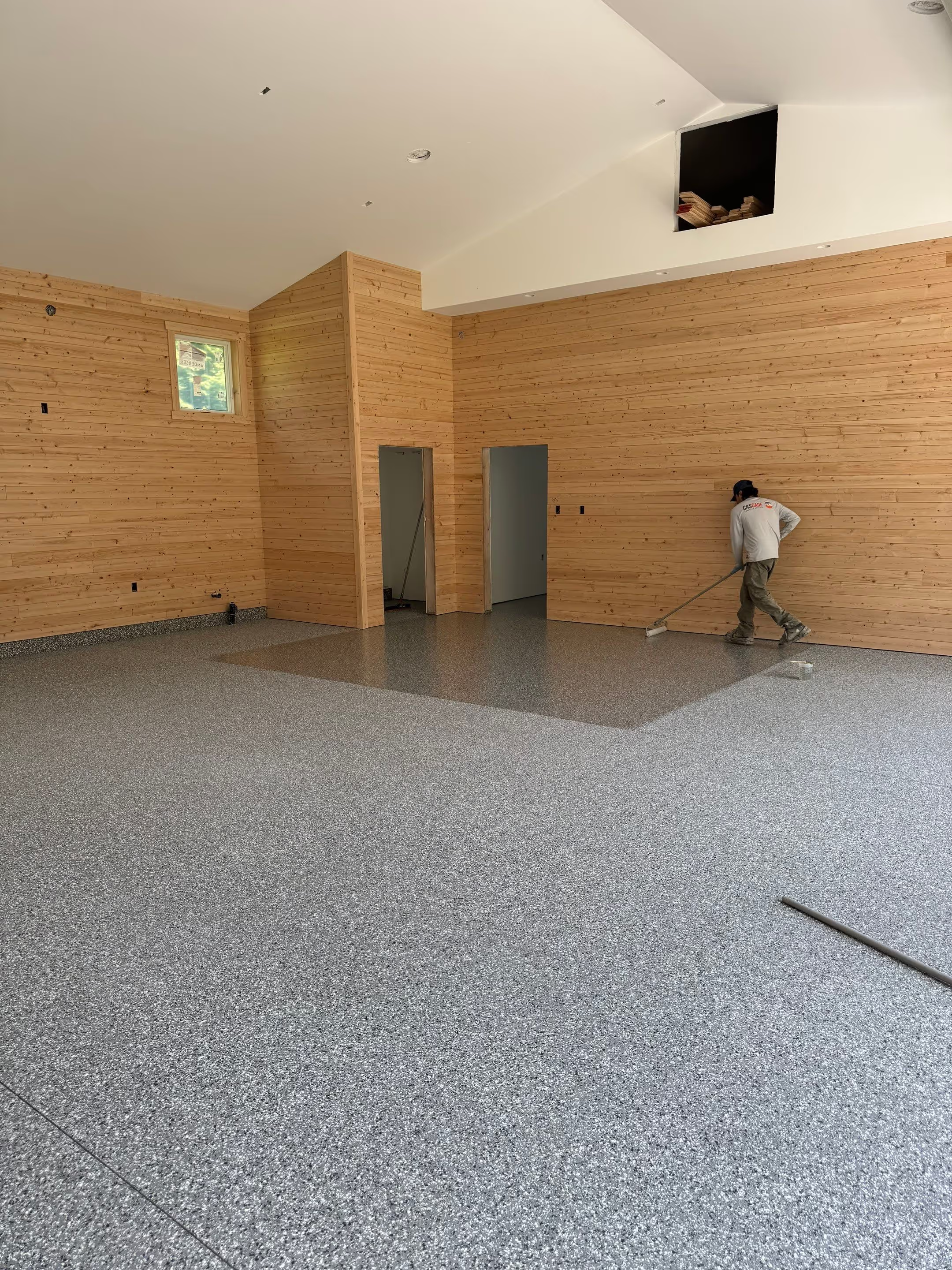
After researching coating chemistry, installation processes, lifetime costs, and warranty coverage, Jennifer's choice became clear. She invested $3,400 in a certified Penntek installation from Cascade Concrete Coatings.
Six years later, her garage floor looks identical to installation day. Zero yellowing. Zero hot tire marks. Zero degradation. She's watching neighbors redo their cheap epoxy floors for the second time while hers remains flawless.
"I spent months researching after my DIY disaster," Jennifer explained. "Once I understood the chemistry—that Penntek creates molecular-level bonds while epoxy just grips the surface—the decision was obvious. I wasn't going to make the same mistake twice."
Throughout Redmond, Sammamish, Bellevue, and the greater Seattle area, educated homeowners are reaching the same conclusion. They're skipping inferior coating options and investing in the only coating system designed to last as long as they own their homes.
When you understand what you're actually buying—the chemistry, the installation process, the lifetime costs, and the warranty protection—the premium option reveals itself as the only economical choice.
Ready to install the garage floor coating that represents your final flooring decision? Contact Cascade Concrete Coatings for a free in-home consultation. We'll test your concrete, explain technical differences in detail, and provide transparent pricing for the coating system you'll never need to replace.
Because now you understand: cheap coatings are expensive, and expensive coatings are cheap—when you calculate over the timeframe that actually matters.